The history of the postcard
Postcards are colourful holiday greetings that people display on their fridge. But in actual fact, it’s not so simple – as a means of communication, postcards are as diverse as the people who write them. Read on for a foray into the history of postcards, between WhatsApp, art, world wars and business communication of past centuries.
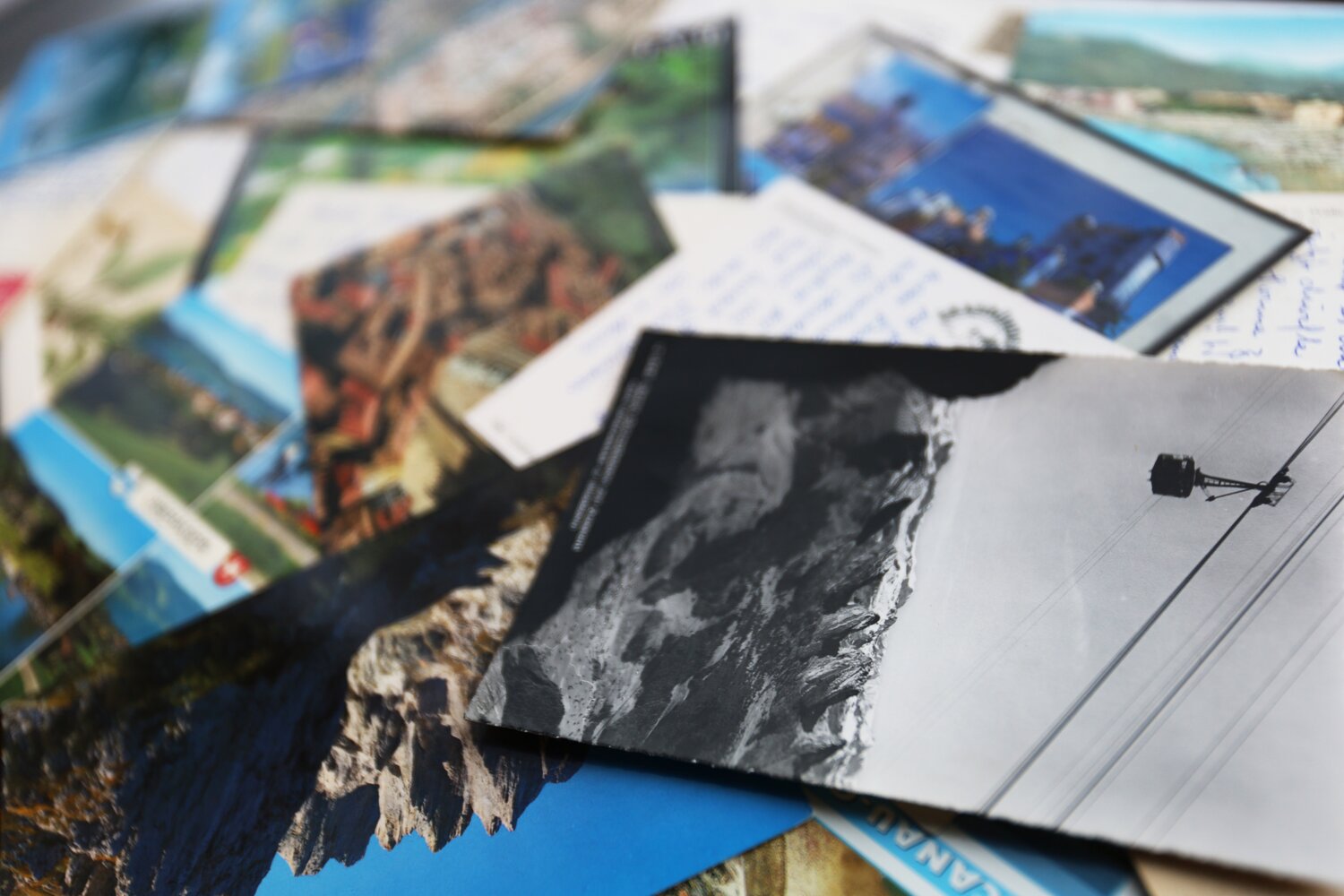
A postcard features an image on the front and an openly readable message on the back. But why send a message that anyone could potentially read? And why does it cost as much to send a postcard as a letter? To answer these questions, we need to look further back in time. The first postcard was issued by Austria-Hungary in 1869, and Switzerland followed suit a year later. The design was functional, with the address on the front, a message on the back and a stamp printed directly on the card. As such, a stamp didn’t need to be purchased separately and the price was cheaper. These so-called correspondence cards bridged a gap in communication between expensive telegraphy and the lengthy letter. They were a cheap, fast and efficient way of sending messages, especially in cities with several deliveries per day.
In the early days, postcards could only be issued by the postal administration, and they soon became very popular. From the 1880s, private publishers were also allowed to produce their own cards – first with little illustrations, then with photos. Advances in printing technology and photography soon allowed for a vast range of designs.


In around 1900, increasing mobility sparked a real postcard boom. Anyone who was travelling sent a sign of life back home. The distances created through mobility were once again bridged by short blogmessages. The images sent were as diverse as the people who sent them.
Within a short space of time, a means of sending short business messages became a widely used and versatile mass medium. Communication technologies evolve together with people, as we can see today with SMS and WhatsApp. To start with, postcards were mainly intended for business communication.
Despite digital alternatives, the postcard has survived. Nowadays, it’s more of a gesture than a necessity – a deliberate analogue statement in a digital world.
Author
Nicolas Kessler, curator of collections in postal- and transportation history and philately, Museum of Communication, Bern and Research Assistant, digital archiving at the PTT archive, Köniz


